
Why 90% of RFID Laundry Tags Fail Before 50 Cycles: A B2B Selection Guide
Managing linen in hospitality, healthcare, or industrial uniform rentals is fundamentally a chaotic, high-stakes asset management challenge. In these environments, an RFID tag is not just a digital label—it is a critical piece of infrastructure that must survive an industrial gauntlet.
Yet, many procurement managers face a frustrating reality: tags marketed as “high-temperature resistant” fail after just a few cycles, or their read range drops from 6 meters to less than 0.5 meters. When a tag fails, visibility is lost, inventory counts break down, and operational costs skyrocket.
Why do some RFID laundry tags fail after 3 cycles while premium ones easily exceed 200 cycles? The answer lies in engineering, material science, and correct specification matching.
The Industrial Wash Cycle: 3 Fatal Killers of Low-Grade RFID Tags
To understand why tags fail, we must look at what happens inside a commercial laundry facility. The typical process—comprising washing (60~85℃), bleaching (80~90℃), neutralizing, high-pressure extraction, and ironing(150~200℃)—presents three fatal challenges to substandard transponders.
1.Thermal Shock during Calender Ironing
During the finishing stage, linens pass through calendar ironers or drying tunnels where temperatures peak between $150^\circ\text{C}$ and $200^\circ\text{C}$. Standard PET-based inlays or poorly encapsulated tags cannot withstand this thermal stress. The layers delaminate, and the solder joints holding the IC (integrated circuit) to the antenna break, causing immediate and permanent signal failure.
2.Mechanical Fatigue from High-Pressure Extraction
Commercial washers use powerful centrifuges or hydraulic extraction presses to remove water, exerting mechanical pressure up to 60 MPa. Under this intense physical compression, the microscopic connections between the chip and the antenna develop micro-cracks. While the tag might survive the first 20 washes, repeated mechanical stress degrades the antenna, drastically reducing the read distance over time.
3.Chemical Corrosion from Aggressive Sanitization
Healthcare and industrial uniform laundering rely on heavy alkalis, acids, and oxidizing agents (like hydrogen peroxide or chlorine bleach) to meet strict hygiene standards. If the tag’s outer encapsulation lacks chemical inertness, the material becomes brittle, cracks, and allows chemicals to seep in, corroding the silicon chip itself.
6 Critical Technical Parameters for B2B Sourcing
| Parameter | Industry Standard Requirement | Technical Significance |
| Temperature Resistance | -60~200℃ | Ensures survival through both deep-freezing storage and high-heat ironing/tunnel drying |
| Wash Lifecycle | ≥ 200 cycles (Hospitality/Healthcare) ≥ 100 cycles (Workwear) | Matches the actual lifespan of high-quality commercial textiles, lowering the Total Cost of Ownership (TCO) |
| Advanced IC Encapsulation | Specialized chip protection packaging | Avoids fragile aluminum-etched or printed antenna joints. Advanced packaging isolates the chip from mechanical and chemical stress |
| Pressure Tolerance | ≥60MPa | Guarantees the tag will not crush or delaminate under heavy hydraulic water-extraction presses |
| IC Selection | RAIN RFID / UHF (e.g., NXP UCODE 9, Impinj Monza) | Crucial for high-density, bulk scanning. Allows hundreds of items to be read simultaneously on conveyors or in cages |
| Read Range | 2 to 8 meters (Reader dependent) | Enables automated inventory tracking at check-in/check-out gates without manual handling |
Scenario-Specific Selection: Matching Tags to Verticals
Different industries place different stresses on textiles. Your RFID selection must align with your specific use case:
- Hospitality Linens: Requires tags with extreme thermal resistance for flatwork ironers, a verified 200+ wash lifespan, and excellent bulk-reading capabilities to scan entire carts of sheets simultaneously.
- Healthcare & Medical Textiles: Prioritizes high chemical resistance against harsh disinfectants, steam sterilization (autoclaving) tolerance, and absolute data traceability for infection control.
- Industrial Laundry & Uniform Rental: Demands high mechanical durability for heavy-duty workwear, compatibility with automated conveyor sorting systems, and long read ranges.
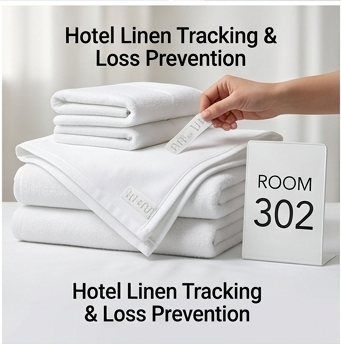
Engineering Reliability: Our Manufacturing Commitment
Choosing an RFID laundry tag is not about buying a consumable; it is about investing in asset security.
Leveraging over 20 years of advanced RFID and smart card manufacturing expertise, we design and produce high-end industrial transponders built for the harshest environments. As an authorized packaging partner for industry-leading silicon providers like NXP and Impinj, we operate dozens of precision encapsulation lines delivering hundreds of millions of tags annually.
Our flagship laundry tag, represents the pinnacle of textile asset tracking:
- Silicon Integration: Powered by the ultra-sensitive NXP UCODE 9 (Impinj chips available upon request) compliant with ISO 18000-6C.
- Form Factor: Compact 70*15 strip, easily laser-engraved or stitched into hems without compromising user comfort.
- Ruggedized Build: Rated for 60 MPa of pressure, 200+ wash cycles, and temperatures ranging from -60~200℃.
Every single batch undergoes rigorous quality control, including EPC/User memory data validation, thermal shock testing, and mechanical stress aging. We provide fully customizable dimensions, IC options, and flexible attachment methods (sewing or heat-sealing) to fit your exact deployment needs.
Contact our engineering team today to request a free sample kit and discover how 20+ years of manufacturing expertise can secure your textile supply chain.